This report will read a bit like a primer for cave diving; apologies to those who already know it all and a "you're welcome" to those that appreciate it :).
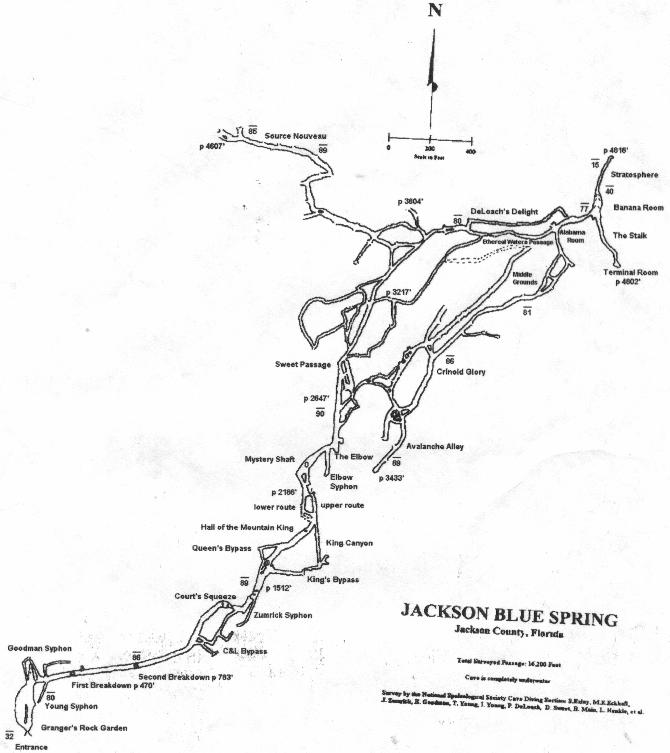
Last weekend my buddy Jason and I dove venerable Jackson Blue, a popular 1st magnitude spring that pumps out an average of 190 cubic feet of fresh water per second. The ( http://www.cavediver.net/pictures/jacksonmap.jpg ) cave system in JB is quite extensive and extends back thousands of feet. Today, however, we limited ourselves to staying relatively close to the entrance (within 500 feet, as the catfish swims :). My buddy recently went from being an (http://www.cavediver.org/introcv.htm) intro cave diver to the level of ( http://www.cavediver.org/apprntc.htm ) apprentice cave diver, which basically means he can now dive with his doubles and leave the main line using reels. Today we chose to do some "reel work", giving him practice in planning and executing dives that involve leaving the main line. I also happen to really enjoy deploying reels, as it gives the dive more of a sense of being on a mission with specific goals to accomplish, all designed to keep intact one of the cornerstone rules of cave diving - cave diver must provide a continuous guideline to the surface.
With this in mind, we looked at the map and planned our jumps:
Horseshoe circuit (first jump to the left, after reaching 90 feet)
Young Syphon (first jump to the right, after reaching 90 feet)
Squirrely Tunnel (second jump to the left, after reaching 90 feet)
Here's a modified map from the larger cave map, zooming in on the area we limited our activities to. I've (crudely :) drawn in the sections of cave that are well-known, but didn't happen to be on the printed map. The yellow line is the location of the permanent main line of the system and it is from which we made our jumps (tied off a reel from this line whenever we went off on a side passage).
http://mail.us.fsu.edu/~jtbauer/cave/JB/JBMap.jpg
I ran the primary from the cavern zone (where we could see open water) and tied off on the gold main line, about 100 feet into the first leg of the cavern zone. We then swam down the first leg, turned right and headed to where the cave drops from 50 feet to 90 feet into a very large room (unfortunately the dinky camera we had coudn't reproduce the size of this area at all).
Jump # 1 - The Horseshoe circuit
I had done this jump before, so I indicated where Jason should tie off on the main line and where he would connect into the jump line. Here he is swimming from the main line to the jump line: http://mail.us.fsu.edu/~jtbauer/cave/JB/07_04.JPG
In this photo, Jason ties off on the jump line and poses for a mug shot. He has looped the line around the jump line and clipped it back onto the reel's line, which leads back to the mainline. If we lost all of our light sources (between us we had six independent dive lights -- two of which are 10 watt HIDs, like the one he's holding in his right hand) we could still get directional information, since the reel "points" the way out. That is, assuming we could find the line! Part of cave training is to do a "lost line" drill, where you pull out your safety reel (stored and used only for this purpose) and, using your sense of touch, tie off, and attempt to find the line. Today's drills, however, were limited to only deploying the reels safely.
http://mail.us.fsu.edu/~jtbauer/cave/JB/10_07.JPG
We then proceeded to swim back up the main line and I ran the second reel from the main line back to the other end of the line that Jason had just tied into. This would set up a circuit, or a circle from one point on the main line, around through another passage and then back to the main line. Here's the circuit drawn in blue: http://mail.us.fsu.edu/~jtbauer/cave/JB/Horseshoe.jpg
The map doesn't really do it justice, but this circuit is a beautiful and challenging swim. Luckily the bottom is mostly sand, which if kicked up settles quickly. A few spots, however, require you to really go slow, controlling your buoyancy as best as possible to avoid hitting the sides, bottom or ceiling. Once we reached Jason's reel I swam over to the main line (any divers who aren't handling the reel should always be on the "safe side" of the reel whenever it's being placed or pulled, to make sure the continuous guideline rule is always in effect for everybody on the team).
Jump # 2 - The Young Syphon
Jason then retrieved his reel and I then indicated where the second jump was going to be made; a mere 25 feet further down the main line. He made the jump and he swam into the new tunnel, along the permanent line indicated in blue, as I followed http://mail.us.fsu.edu/~jtbauer/cave/JB/YSyphon.jpg
This is another pretty passageway that is quite large. It is a dead end that pinches up to a restriction as you get closer to the end. Here's a picture of how the line is routed near the restriction: http://mail.us.fsu.edu/~jtbauer/cave/JB/13_10.JPG
An interesting story about the restriction -- Jason tried to squeeze through it first (I wish I had thought to take a picture; oh, well), but couldn't figure out where to go. It was like a jig saw puzzle. He was careful in his wigglings and didn't stir up much silt so I was able to see a better spot to try. I couldn't really tell him easily how to do that, and when he eventually backed out I signaled for me to try. I was able to squeeze past just fine and he followed right behind me. Low and behold, on the floor was a backup dive light that a previous caver must have lost! I figured finder's keepers, so I stuck it in my drysuit leg pocket. We then followed the line as it hooked up to the left and terminated, tied off to this rock where I'm giving the "OK" http://mail.us.fsu.edu/~jtbauer/cave/JB/15_12.JPG
On the way back I decided to explore another line that I had noticed on the way in. It's the green line in the last map. Here I am setting the reel on the permanent line: http://mail.us.fsu.edu/~jtbauer/cave/JB/17_14.JPG
A mere 10 feet away I swim to the second permanent line that will then connect the "blue" line with the new "green" line http://mail.us.fsu.edu/~jtbauer/cave/JB/19_16.JPG
Finally I "OK" Jason when the reel is secured. This now means we are three permanent lines and four reels away from the surface! Again, though, notice how each reel will always point the way out in case of loss of visibility.
http://mail.us.fsu.edu/~jtbauer/cave/JB/20_17.JPG
Here's the ";green tunnel" enticing us to swim along it. For me this was a new piece of cave that I had not been in before, even though I suspected I knew where it went.<http://mail.us.fsu.edu/~jtbauer/cave/JB/21_18.JPG"
When we reached the end of the "green line" I found myself back in the main cave tunnel, with the main line an arm's length away. Technically I should have either turned the dive and gone back the way we came or just connected the two lines. I chose to do a "visual jump" or "blind jump" by simply swimming over to the main line. I turned back and made sure that Jason also made the jump. We then swam back along the main line and both re-entered on the "blue" line to retrieve our reels. This is where Jason made a bit of a snafu. I went in first and while I was disconnecting the green line from the blue line Jason chose to disconnect the green line from the main gold line. This meant that I was now in a situation where the line I was swimming on had no continuous path back to the surface! Later on we debriefed on this and I slightly admonished Jason on his judgment; he should have gone with me to grab the green line reel and then I would follow him to retrieve the blue line reel. I chalked this up to his learning curve and me not doing a more detailed pre-dive briefing.
Luckily the visibility was still excellent. I even covered my light head while swimming back towards Jason, just to see if I could see his light and his HID light shown like a beacon.
#3 - The Squirrely Tunnel
We clipped off our reels and, after checking our gas to make sure we were still within our 1/3rd air supply, we proceed across the cave to set up the final circuit. It was Jason's turn to do the reel, so I showed him where the permanent line for this tunnel was located (it's the purple line):
http://mail.us.fsu.edu/~jtbauer/cave/JB/Squirrely.jpg
I led the dive after Jason set the reel, since I had been down this road before and warned Jason that it was pretty tight in some spots. I figured he could fit the cave better if he first saw how I chose to wriggle through. This passage is also beautiful, but it is indeed somewhat squirrely, requiring even better buoyancy and fin control than the other trails we had been down already. The last part is the most challenging, where you scrape up and out to find the main line. Here's a shot of Jason after he's completed the circuit, looking wary but happy :)
http://mail.us.fsu.edu/~jtbauer/cave/JB/27_24.JPG
We swam back out on the main line and Jason retrieved his reel from his last jump. We then exited the cave, where I retrieved the second reel we had set up on the horseshoe circuit and finally the primary. All in all, an excellent skills dive for both of us and a welcome change from the usual "go as far as you can until you have to turn" dive.
Dive Data
We spent 88 minutes under water, 15 minutes of which we took turns breathing 100% oxygen at 20 feet during the required decompression. We both were breathing a Nitrox mix of 35% otherwise. Max depth seen was 92 feet and the average (skewed by the 15 minutes at 20 feet) was 60 feet."