


 Gators, Garfish, Cormorants, Oh My!
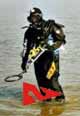
After two years of planning, drought, weather delays, today we dove Apopka Springs, in Gourd Neck, Lake Apopka, Orange County. Lake Apopka once a premier bass fishing lake is all but dead due to muck farming on the north shore during the 1940’s to 1970’s. The bottom is coated with a brown pudding like substance that clogged my boat motor intake and nearly ended the trip several hundred feet from our launch site. Once clear of the muck we easily boated across the lake to the Gourd Neck area seeing white pelicans and gators all along our route. Upon arriving at Gourd Neck we found three boats bass fishing in and around the boil. Waiting until the boats moved on we anchored with a bow anchor and an aft anchor. Curt, my diving buddy dropped the aft anchor directly into the boil. Suiting up with single steel tanks we also dropped two AL80’s over the side on a 10 foot nylon line. These bottles we clipped off as stages and proceeded down the anchor line. It should be noted that the water issuing from Apopka Spring was not real clear but clear enough for us to see many giant garfish (3 to 5 feet in length) cruising around the spring area. At about 30 feet we broke through the stained lake water into crystal clear spring water of 75 degrees, only to find a mass of tree branches covering the vent hole to the spring. Our anchor was clearly visible below us dead center in the vent.
Curt wiggled his way through the branches and tied off a primary line. There was a lot of mono filament line, a few bobbers and other fishing junk littering the cavern area. It always amazes me to fine this junk yet the worse was yet to come. Moving into the cave with mostly white limestone walls with dark spots I spied a shinny sign “In Remembrance of Danny Smith & Kevin Gokey” (see attached photo). I don’t know the story behind these people perhaps someone of the board does. Moving from the cavern to the cave area we found many beer cans, and other debris like a fishing landing net, sardine cans, and cement blocks. Curt stopped only about 150 feet into the cave where the tunnel took a narrow drop down under a tight ledge and could go no further. After trying several minutes to get past this area (filled with beer bottles and cement blocks) (and many catfish) he tied off and cut his line. Backing out he motioned me forward to see if I could get any further, I couldn’t. We turned the dive. I snagged on mono filament several times, but using my knife cut myself free. Back at our anchor Curt ascended into a swirling mass of debris. So numerous were the particles that they block out my HID light unless it was 2” from my mask. I could feel the debris rushing by me but I could move only by Braille. I kept a tight hand on the anchor line. I did a stop at approximately 15 feet but couldn’t be sure as I still couldn’t see my gages. A few feet up I felt Curt’s tank so I just hung there doing my three minutes. After a few minutes Curt turned to me and touched my hand with an OK. I signaled back and he was gone. Upon surfacing I found that Curt wasn’t at the tank at 15 feet. It was his stage bottle he had clipped it off and went to the surface. Worrying about if I had exited the cave he had come back down the anchor line to find me at 15 feet.
Summary: If you are going to dive this cave we believe you should sidemount. With a sidemount you should be able to get by the restriction where we stopped. There wasn’t line in there when we entered but there is one now. You absolutely must have a line to the surface. Our anchor line was that line. Had we tied off on a tree branch at the vent mouth we might have been lost in the massive debris that followed us up into the boil. A better type of boat to do this dive would have been a pontoon boat which would have given a more stable platform. Finally, you had better not be nervous about big fish, gators or diving cormorants as they were all around us. (Gator’s were very close to us and looked to be over 10 feet in length.

Welcome to the Cave Diver's Forum.
 Reply With Quote


 Slippery when wet-!
 Originally Posted by curtschu

 ...one or the other-! Good grief, Curtis......you guys must really have been bitten hard by the 'cave' bugs-! Lol.....I loved it. See, if it bites, you can find a place to dive close to home-

Bookmarks